A Megawatt Solar Project's Journey from Land to Power Plant
Commercial Solar
•
10 February, 2026
The process of turning vacant land into a fully functional megawatt solar power plant is thrilling and lucrative. The growing demand for clean energy and the rising cost of power have made megawatt-scale solar installations one of the most alluring investments for energy producers, businesses, and landowners. But just how can a plot of land become an asset that generates electricity? Let's have a look at the straightforward, diagrammatic explanation of the whole lifespan of a megawatt solar plant.
1. Land Identification & Feasibility
Land selection is the first step in each megawatt solar project. Not every piece of land can accommodate a solar power plant. Important prerequisites: • At least 4-5 acres per MW • Adequate solar irradiation, or the availability of sunlight • Level or gently sloping terrain • Access to roads for transit • A nearby transmission line or power substation
2. Approvals & Power Purchase Agreement (PPA)
The legal and regulatory processes start as soon as the site is technically viable. Among the major approvals are: • Conversion of land, if it is agricultural • Permissions from the state electrical board • Approval of grid connections • Environmental approvals, if necessary Agreement for the Purchase of Power (PPA) A PPA is an agreement to sell the plant's power. Project viability ↓ Submit an application for grid connectivity ↓ Discuss tariffs with DISCOM or the private buyer ↓ Sign a power purchase agreement (PPA) ↓ The project becomes bankable Long-term revenue is guaranteed by a signed PPA, which aids in obtaining project finance.
3. Project Financing
Megawatt solar projects require significant investment, but banks and investors are eager to fund them due to stable returns. Financing Sources: • Bank loans (70–80% project cost) • Private investors • Solar developers • Government schemes (like KUSUM for certain categories) Signed PPA ↓ Project Cost Estimation ↓ Loan Application to Bank/NBFC ↓ Financial Closure Achieved Financial closure means funds are secured, and the project is ready for execution.
4. Engineering & Design (E in EPC)
This is where the technical planning begins. Engineering Activities: • Plant capacity design (1MW, 2MW, 5MW+) • Module layout planning • Inverter sizing • Cable routing & electrical design • Structure design based on wind load Design Flow Land Survey Data ↓ Plant Layout Design ↓ Electrical Single Line Diagram (SLD) ↓ Civil & Structural Drawings ↓ Final Engineering Approval A strong design ensures maximum power generation and long-term durability.
5. Procurement (P in EPC)
Now, all major components are purchased. Major Equipment: • Solar panels (modules) • Solar inverters • Mounting structures • Transformers • Cables & SCADA monitoring system Final Engineering Design ↓ Vendor Selection ↓ Quality Inspection ↓ Material Delivered to Site Quality procurement directly impacts plant efficiency for 25+ years.
6. Construction (C in EPC)
This is where the land physically transforms into a solar power plant. Construction Activities: • Land levelling • Foundation work • Mounting structure installation • Solar panel installation • Inverter and transformer setup • Internal cabling
7. Construction Flow
Site Mobilization ↓ Civil Foundation Work ↓ Mounting Structure Installation ↓ Solar Module Mounting ↓ Electrical Wiring & Inverter Setup Within 3–6 months (depending on project size), the plant structure becomes visible.
8. Grid Connection & Commissioning
Once installation is complete, the plant is tested and connected to the electricity grid. Commissioning Steps: • Electrical testing • Inverter synchronization • Protection system checks • Inspection by electricity board Installation Complete ↓ Pre-Commissioning Tests ↓ Grid Synchronization ↓ Final Inspection ↓ Plant Commissioned At this moment, the plant starts generating electricity and revenue.
9. Operation & Maintenance (O&M)
A solar plant is not “install and forget.” Proper maintenance ensures peak performance. O&M Includes: • Regular panel cleaning • Inverter health checks • Monitoring through SCADA • Preventive maintenance • Security and vegetation control Plant Operational ↓ Real-Time Monitoring ↓ Scheduled Maintenance ↓ Performance Optimization A well-maintained plant can operate efficiently for 25 years or more.
10. How Revenue is Generated
Once operational, electricity flows to the grid and payments begin as per the PPA. Sunlight ↓ Solar Panels Generate DC Power ↓ Inverters Convert DC to AC ↓ Transformer Steps Up Voltage ↓ Power Supplied to Grid ↓ Electricity Sold to DISCOM / Buyer ↓ Monthly Revenue Earned This creates a steady, predictable income stream for the project owner.
11. Environmental & Business Impact
Megawatt solar plants are not just profitable — they also support sustainability. Benefits: Reduces carbon emissions Productive use of unused land Long-term fixed electricity cost Energy independence for industries Supports government renewable goals
Final Overview Diagram Here’s the complete journey in one simple flow: Land Selection ↓ Feasibility Study ↓ Approvals & PPA ↓ Financing ↓ Engineering Design ↓ Procurement ↓ Construction ↓ Grid Connection ↓ Power Generation ↓ Revenue for 25+ Years
Conclusion
The process from land to megawatt solar power plant is a well-organized one that includes funding, legal permissions, technical planning, and skilled EPC execution. The transition is easy, quick, and very satisfying when managed by a skilled solar EPC business. A megawatt solar project is a long-term asset that produces electricity, profit, and environmental value for businesses and landowners. It is more than just an energy solution. Now is the ideal moment to investigate megawatt solar investment and join the clean energy future if you have sufficient property or wish to lower industrial power prices.
Table of Content
- Introduction
- Land Identification & Feasibility
- Approvals & Power Purchase Agreement (PPA)
- Project Financing
- Engineering & Design (E in EPC)
- Procurement (P in EPC)
- Construction (C in EPC)
- Construction Flow
- Grid Connection & Commissioning
- Operation & Maintenance (O&M)
- How Revenue is Generated
- Environmental & Business Impact
- Conclusion
Related Posts
Smart Energy for Smart Businesses: How Commercial Solar Solutions Lower Industrial and Commercial Building Electricity Costs
One of the most significant operating costs for businesses, apartment complexes, hospitals, hotels, and gas stations is electricity. Businesses are actively looking for solutions to lower monthly power expenditures without sacrificing energy quality or dependability due to growing energy prices and a greater emphasis on sustainability. With long-term financial benefits, energy independence, and a reduced carbon footprint, commercial solar energy solutions have become a clever, economical, and environmentally responsible substitute for traditional grid electricity.
The Top Benefits of Solar Panels for Commercial Buildings 2025
All solar panels for commercial buildings appear to have answered the call in becoming the solution to sustainability and cost savings. Thanks to technology, 2025 presents itself to be a game-changing year for businesses that want to minimize energy costs, switch to lower-carbon alternatives, and enhance their marketability. Commercial Solar Solutions supports businesses and commercial establishments save on utility bills while improving their credibility in environmental stewardship—a much-valued aspect in modern business. Without a doubt, from small offices to large industrial complexes, recognizing the benefits of solar panels can create the most value for your enterprise, provide it with increased competition and resilience, and better ensure sustainable operations. Solar panels for commercial buildings stand out, in that they provide a game-changing solution to renewable energy by being a means for cost savings, as well as a way for sustainability in the ecosystem and regulatory compliance with the present stakeholders.
Having an industry or commercial building in Bhopal, Madhya Pradesh gives you easy access to commercial solar panel installations. One of the best plans that you can cater to is “Rooftop Commercial Solar Panels”. But how?
Let us explore the key benefits in detail in a segmented view of actionable insights.
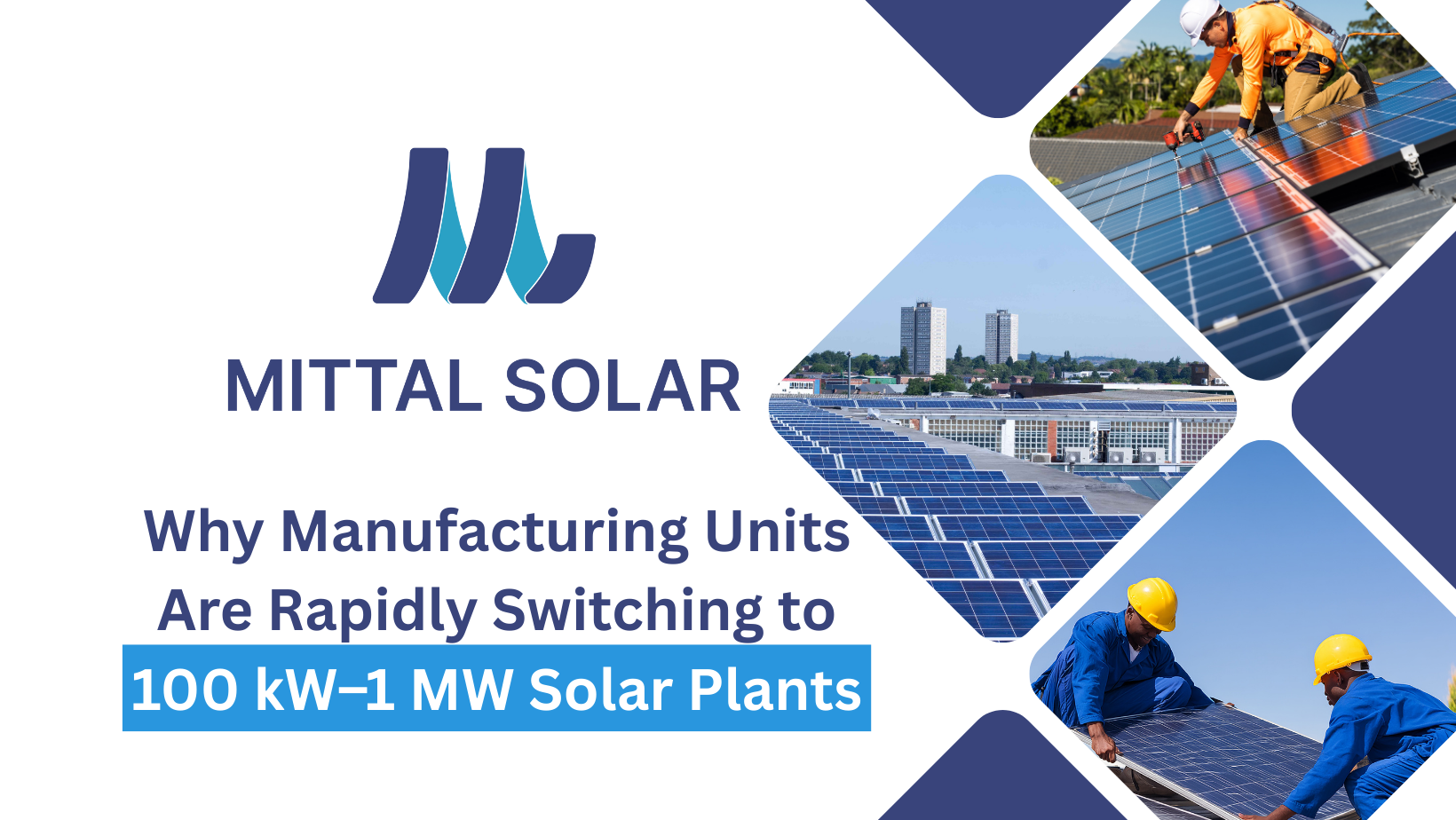
Why Manufacturing Units Are Rapidly Switching to 100 kW–1 MW Solar Plants
India’s manufacturing sector is going through a major transformation. With rising electricity costs, increasing competition, and rapid technological advancement, industries are now looking for smarter, cleaner, and more economical ways to run their operations. Among all solutions available today, 100 kW to 1 MW solar power plants have emerged as the most reliable, cost-effective, and future-ready energy source for factories and industrial units.
From textile mills to plastic molding units, metal fabrication workshops to food-processing plants, businesses across India are adopting solar not just as an energy source but as a long-term strategic investment for sustainable growth. This blog explains why industrial units are rapidly switching to 100 kW–1 MW solar systems, and how this shift is reshaping the operational efficiency of the manufacturing ecosystem.