Smart Energy for Smart Businesses: How Commercial Solar Solutions Lower Industrial and Commercial Building Electricity Costs
Commercial Solar
•
10 January, 2026
One of the most significant operating costs for businesses, apartment complexes, hospitals, hotels, and gas stations is electricity. Businesses are actively looking for solutions to lower monthly power expenditures without sacrificing energy quality or dependability due to growing energy prices and a greater emphasis on sustainability. With long-term financial benefits, energy independence, and a reduced carbon footprint, commercial solar energy solutions have become a clever, economical, and environmentally responsible substitute for traditional grid electricity.
1. The Significance of Commercial Solar for Businesses
Large-scale solar installations intended for commercial use have advanced considerably, thus solar energy is no longer only for residential use. This is the reason: 1. Massive Reduction in Electricity Bills High-powered equipment, lighting, HVAC systems, and round-the-clock services are frequently used in commercial buildings. Large amounts of electricity are used as a result, and costs increase. Your daily energy needs can be largely or even entirely met by a solar system, which results in: Decreased Peak Demand Fees , Predictable Energy Costs, Lower Monthly Bills Depending on system size and power needs, companies often experience a 40–70% decrease in energy costs in the first year.
ROI and Payback in 3-6 Years In three to six years, commercial solar systems usually pay for themselves through utility savings. With panels lasting at least 25 years, the energy generated after payback is nearly pure profit.
Security of Energy Businesses are less reliant on blackouts and grid failures when solar and battery storage are combined, which is very advantageous for vital infrastructure such as data centers, hotels, and hospitals.
Green Business Credentials Partners and customers are favoring eco-friendly companies more and more. In addition to improving a brand's reputation, solar energy can be utilized for sustainability certifications and CSR reporting.
2. Who Gains the Most from Business Solar?
Because solar energy is so adaptable, almost any business can profit from it, although some industries Solar stand to gain more than others:
Manufacturing Facilities & Industrial Units Energy-intensive processes including cooling systems, compressors, and furnaces are frequently operated in factories. Bills every month can be debilitating. Benefits: High energy offset Lower maintenance costs compared to diesel generators Cleaner industrial footprint Lower peak hour demand charges In places where grid electricity may fluctuate, solar additionally enhances power availability Housing Societies & Residential Complexes Power is used in large multi-tower societies for: Clubhouses, water pumping systems, security systems, elevators, and communal lighting The common area electricity cost of the community can be significantly reduced by installing solar, freeing up money for maintenance reserves. Benefits of Community Solar: Potential net metering credits from excess generation Transparent electricity billing Reduced maintenance costs
Medical Facilities & Hospitals Power outages are not tolerated in hospitals. Additionally, they have heavy loads throughout the day and at night from life-saving equipment, HVAC, and lighting. Solar Benefits: Redundancy with solar and battery backup; reduced operating expenses; dependable electricity in an emergency; and support for a patient-safe environment When combined with UPS/battery systems, solar energy truly becomes a savior.
3. Habitations & Hospitality Sector
Hotels have air conditioning, lights, laundry, and kitchens that run around the clock. Monthly bills are directly impacted by peak electricity demands.The advantages of solar energy for hotels * Significant daytime load offset * Enhances brand perception as sustainable * Promotes eco-tourism credentials * Quick return on investment
4. Retail Complexes & Petrol Pumps
Convenience stores, display panels, lighting, and nearly constant pump operation are all features of gas pumps. Solar benefits: * Supports rural or low-grid areas * Lowers energy costs for pumps and lighting * Will be able to power EV charging stations in the future Additionally, putting solar panels on display at gas stations enhances business green branding.
5. Commercial Solar Solution Types
Solar setups differ from one another. Your budget, roof availability, and energy requirements all play a role in selecting the best solution. Grid-Tied Solar Systems with *Integrated with the utility power grid * Exports excess power back to the grid * Net metering allows businesses to earn credits Ideal for the majority of commercial and industrial structures.
6. Hybrid Solar Systems
Reduces dependency on grid power Integrates solar and battery storage provides backup power in the event of an outage.Perfect for facilities with constant power needs, hospitals, and vital activities.
7. Off-Grid Solar Systems
Completely unreliant on the electrical grid Utilizes generators and batteries Ideal for isolated areas with unstable grid Off-grid solutions are advantageous for standalone facilities like gas stations in rural locations.
8. Profit Strategies & Financial Incentives
Globally, utilities and governments are providing incentives to hasten the adoption of solar energy. Commercial installations in India and other areas could get:
Financial Assistance
The initial cost of investment is reduced by upfront subsidies.
- Net Metering*
By exporting excess power to the grid, solar systems can create credits that lower your utility costs.
Tax Advantages
ROI is increased via tax deductions and accelerated depreciation.
Green Financing & Loans
Solar is financed by numerous banks and NBFCs at competitive interest rates. Options for No Down Payment Businesses can use solar energy without having to pay for it up front thanks to leasing and PPAs (Power Purchase Agreements). The effective cost of a business solar system decreases dramatically with these incentives, increasing ROI and reducing payback periods.
9. The Value of Professional Solar Advice
Solar energy is not a simple plug-and-play system. Performance and cost reductions are greatly impacted by proper design, installation, and continuing support.
What a skilled solar consultant offers is as follows:
☑ Load Analysis
determines the ideal solar system size by analyzing the company's past energy consumption and peak demand.
☑ Site Evaluation
evaluates structural capability, orientation, shading, and roof conditions—all of which are essential for the best possible placement of panels.
☑ Personalized System Design
Every company has different needs, ranging from inverter configurations to battery storage options.
☑ Modeling Finances
precise estimates of the entire lifespan savings, IRR, payback timeframe, and billing savings.
☑ Approvals & Compliance
navigating regulatory paperwork, net-metering procedures, permits, and subsidy applications.
☑ Quality Assurance & Installation
guarantees strong warranties, professional installers, and premium parts like Tier-1 panels.
☑ Monitoring & Operation
Maintenance plans, performance reports, and remote monitoring all aid in increasing output.
10. The Best Arguments Against Postponing Solar Adoption
- Solar technology is more efficient than ever; * Financing and incentives are improving; * Solar increases sustainability credentials; * Solar offers energy independence; * Competitive enterprises are already adopting
Conclusion
For businesses, housing societies, hospitals, hotels, gas stations, and other establishments with high electricity costs, commercial solar solutions are now a strategic business decision rather than a futuristic alternative. Long-term savings, predictable energy costs, outage resilience, and significant environmental advantages are all provided by solar.
However, professional solar consultation is the key to unlocking maximum return, from precise system sizing to installation and maintenance. You may more effectively, consistently, and profitably capture solar energy with the right knowledgeable partner.
Table of Content
- Introduction
- The Significance of Commercial Solar for Businesses
- Who Gains the Most from Business Solar?
- Habitations & Hospitality Sector
- Retail Complexes & Petrol Pumps
- Commercial Solar Solution Types
- Hybrid Solar Systems
- Off-Grid Solar Systems
- Profit Strategies & Financial Incentives
- The Value of Professional Solar Advice
- The Best Arguments Against Postponing Solar Adoption
- Conclusion
Related Posts
Smart Energy for Smart Businesses: How Commercial Solar Solutions Lower Industrial and Commercial Building Electricity Costs
One of the most significant operating costs for businesses, apartment complexes, hospitals, hotels, and gas stations is electricity. Businesses are actively looking for solutions to lower monthly power expenditures without sacrificing energy quality or dependability due to growing energy prices and a greater emphasis on sustainability. With long-term financial benefits, energy independence, and a reduced carbon footprint, commercial solar energy solutions have become a clever, economical, and environmentally responsible substitute for traditional grid electricity.
The Top Benefits of Solar Panels for Commercial Buildings 2025
All solar panels for commercial buildings appear to have answered the call in becoming the solution to sustainability and cost savings. Thanks to technology, 2025 presents itself to be a game-changing year for businesses that want to minimize energy costs, switch to lower-carbon alternatives, and enhance their marketability. Commercial Solar Solutions supports businesses and commercial establishments save on utility bills while improving their credibility in environmental stewardship—a much-valued aspect in modern business. Without a doubt, from small offices to large industrial complexes, recognizing the benefits of solar panels can create the most value for your enterprise, provide it with increased competition and resilience, and better ensure sustainable operations. Solar panels for commercial buildings stand out, in that they provide a game-changing solution to renewable energy by being a means for cost savings, as well as a way for sustainability in the ecosystem and regulatory compliance with the present stakeholders.
Having an industry or commercial building in Bhopal, Madhya Pradesh gives you easy access to commercial solar panel installations. One of the best plans that you can cater to is “Rooftop Commercial Solar Panels”. But how?
Let us explore the key benefits in detail in a segmented view of actionable insights.
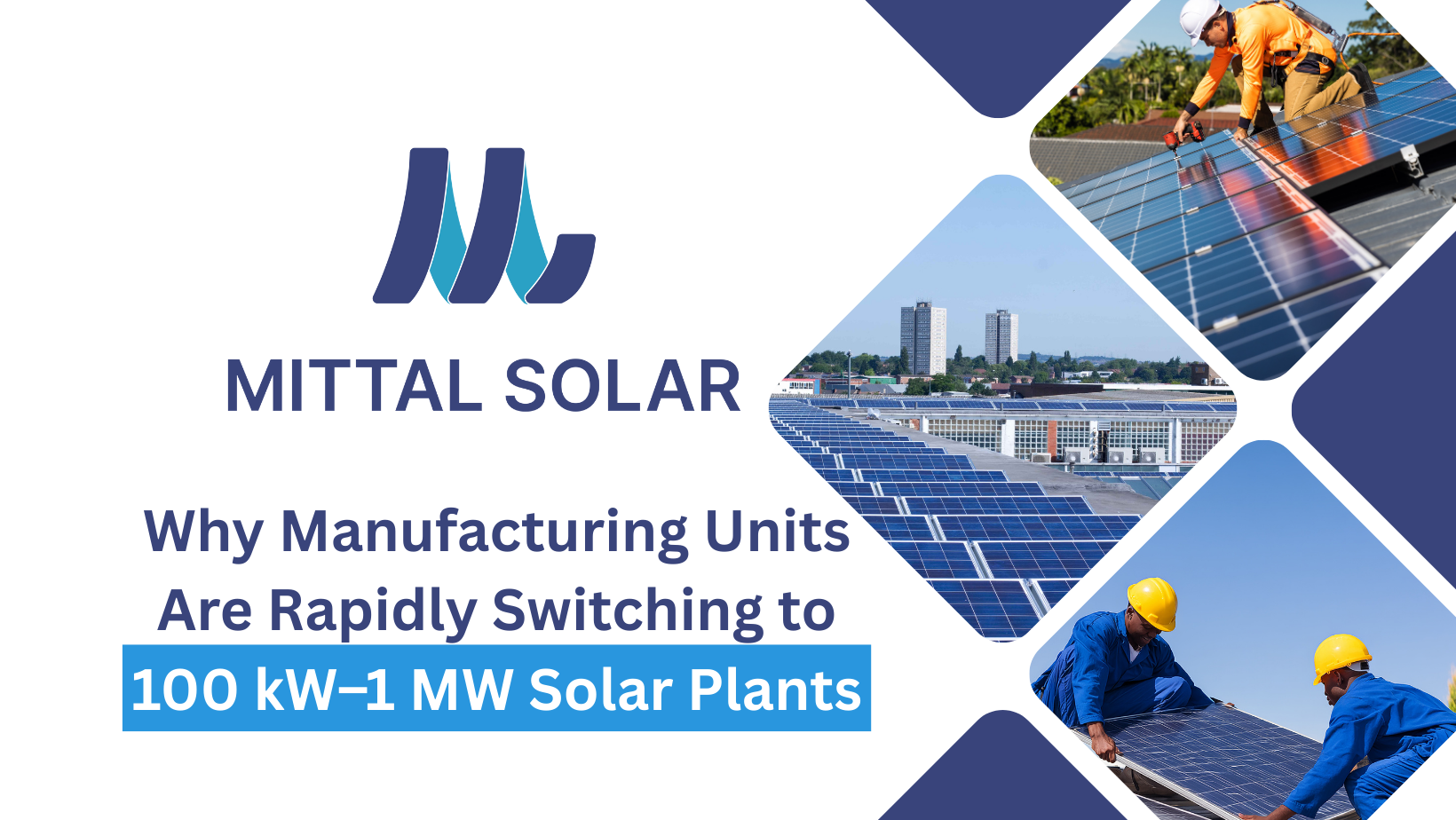
Why Manufacturing Units Are Rapidly Switching to 100 kW–1 MW Solar Plants
India’s manufacturing sector is going through a major transformation. With rising electricity costs, increasing competition, and rapid technological advancement, industries are now looking for smarter, cleaner, and more economical ways to run their operations. Among all solutions available today, 100 kW to 1 MW solar power plants have emerged as the most reliable, cost-effective, and future-ready energy source for factories and industrial units.
From textile mills to plastic molding units, metal fabrication workshops to food-processing plants, businesses across India are adopting solar not just as an energy source but as a long-term strategic investment for sustainable growth. This blog explains why industrial units are rapidly switching to 100 kW–1 MW solar systems, and how this shift is reshaping the operational efficiency of the manufacturing ecosystem.