Is Rooftop Solar Ready for Your Industry? Important Signs You Should Be Aware Of
Commercial Solar
•
27 November, 2025
India's industrial sector is going through a significant energy revolution. Warehouses, commercial buildings, fabrication factories, and industrial facilities are all quickly switching from costly grid electricity to high-efficiency rooftop solar systems. However, the crucial query still stands: Is your sector prepared for rooftop solar? Before making an investment in a high-capacity system, such as a 50 kW, 100kw solar system, 250 kW, or even a full-scale 1 MW rooftop plant, it is imperative to comprehend this. The key signs, technical indicators, and business triggers that help you assess whether your industrial facility is ready to embrace solar energy will be covered in this article.
1. Every quarter, your electricity bills increase
The steady growth in your electricity bills is the first and most noticeable symptom. Heavy machinery-using industries, like food processing companies, packaging facilities, metal fabrication facilities, and textile mills, frequently observe: * Increased demand charges (based on KVA) * Increasing diesel generator (DG) costs * Increased per-unit rates * High daytime power demand Depending on your usage habits and state regulations, rooftop solar can significantly lower your power costs by up to 60–90% if your monthly electricity bill has above ₹1.5–3 lakh. Daytime consumption predominates, and your monthly bill is consistently high. This is a key indicator of readiness.
2. Your Rooftop Is Unused and Shadow-Free
The availability of a big, shadow-free roof is a major factor in the performance of an industrial rooftop solar system. Your sector is prepared for solar power if:
- There are four to five hours of direct sunlight every day on your rooftop. No significant shadows are cast by neighbouring structures, chimneys, or buildings. The strength of your roof allows you to support solar mounting structures.
- At least 7–10 sq. ft. per kW are available for installation. Your roofs are made of PEB, GI sheets, or RCC. For instance: Approximately 6,000–8,000 sq. ft. are needed for a 100 kW plant, and 35,000–40,000 sq. ft. may be needed for a 500 kW rooftop system. The main indicator of readiness is that you have enough rooftop space and adequate sunshine exposure.
3. The Daytime Load Consumption in Your Industry Is High
During the day, industrial solar rooftop systems produce the most energy. Businesses that function during: * Working one shift (9 AM to 6 PM) * Working two shifts * Ongoing production (24/7 Because their peak load corresponds with their peak solar generation, they are perfect for rooftop solar in Bhopal. High-daytime-consumption industries include: * Higher savings * Quicker return on investment * Improved grid stability * Less reliance on DG sets Key readiness sign: The hours when you use solar power are when you use the most power.
4. You Want to Reduce the Cost of Diesel Generators (DG)
Because of power interruptions or variations, many companies continue to rely on diesel generators. If DGs are widely used in your sector, rooftop solar can lower: * Use of diesel; * Cost of operation (₹18–25 per unit on DG vs. ₹2-4 on solar); * Air pollution and noise; * Risk of breakdown and maintenance By supplying steady power during the day, solar also lessens the strain on generators. The key readiness sign is: You want a less expensive backup solution because your DG expenses are going higher.
5. You Desire Predictable Energy Prices and Long-Term Cost Stability
Regular fluctuations in grid electricity charges are caused by: * Changes in government policies * Variations in demand charges * Fuel price adjustments * Electricity duty Solar provides a low-maintenance fixed power source for 25+ years. Early adoption of solar is recommended for industries seeking reliable long-term cost planning. Key readiness sign: You want to see stability in energy prices over the next 15 to 25 years
6. Your Sector Desires to Meet Client Compliance and Boost ESG Score
Supply chains in India and throughout the world are now requesting: * Sustainable production; * Green energy compliance; * ESG reporting; * Low-carbon manufacturing If your sector works with international brands or export customers, you need to demonstrate: * Adoption of renewable energy * Reduction of carbon emissions * Clean energy sourcing Putting in rooftop solar enhances your reputation and raises your sustainability score. Clean energy activities are necessary for your clients or certificates. This is a key indicator of readiness.
7. Solar Integration is Supported by Your Electrical Infrastructure
A few technological requirements must be met by industrial spaces: Accurate load distribution; stable MCC, PCC, or LT/HT panels; adequate authorized load; safe cable routing; and proper earthing and grounding To make sure your electrical setup can safely manage a rooftop solar plant, EPC providers do a site survey. Key preparedness sign: The electrical infrastructure in your building is reliable and the load distribution is appropriate.
8. Your Sector Desires Quick ROI and Tax Advantages
Businesses that use solar rooftop systems benefit from: * GST Input Credit * Accelerated Depreciation (40%) * Zero fuel cost * Low maintenance * 25-year performance warranty Industrial solar solutions in Bhopal is one of the best long-term industrial investments, offering ROI within 3–5 years depending on your location and consumption. Key preparedness sign: You want to invest in low-risk, high-return infrastructure.
9. You See Power Variations Impacting Equipment
Businesses that use delicate machinery, such as CNC machines, compressors, blowers, chillers, moulding machines, or automated lines, frequently encounter: * Power outages * Variations in voltage * Motor damage * Production stops During the day, solar provides steady direct power, which lessens these variations.Your productivity is being impacted by an unstable power supply, which is a critical readiness indicator.
10. You Need More Power Capacity Because You Plan to Expand
If your sector is increasing working hours, expanding building capacity, adding new equipment, and scaling production, The electrical department may need to approve a larger load, which takes time. By supplying more power capacity straight from your rooftop, solar helps lessen reliance on approved loads. Your manufacturing expansion calls for more reasonably priced power, which is a key readiness indicator.
Conclusion
Is Rooftop Solar Ready for Your Industry? Your business is completely ready for an industrial rooftop solar system if you can identify 5 or more of the signs listed above. Rooftop solar is now a profit-boosting, sustainability-driven, long-term business investment rather than just a "cost-saving option." Early-switching industries benefit from: * Significantly lower electricity costs * Quicker return on investment * Reduced carbon footprint * Energy independence * High client credibility The sooner your industry embraces the green, stable, and solar-powered future of industrial energy, the larger the operational and financial advantages.
Table of Content
- Introduction
- Every quarter, your electricity bills increase
- Your Rooftop Is Unused and Shadow-Free
- The Daytime Load Consumption in Your Industry Is High
- You Want to Reduce the Cost of Diesel Generators (DG)
- You Desire Predictable Energy Prices and Long-Term Cost Stability
- Your Sector Desires to Meet Client Compliance and Boost ESG Score
- Solar Integration is Supported by Your Electrical Infrastructure
- Your Sector Desires Quick ROI and Tax Advantages
- You See Power Variations Impacting Equipment
- You Need More Power Capacity Because You Plan to Expand
- Conclusion
Related Posts
Smart Energy for Smart Businesses: How Commercial Solar Solutions Lower Industrial and Commercial Building Electricity Costs
One of the most significant operating costs for businesses, apartment complexes, hospitals, hotels, and gas stations is electricity. Businesses are actively looking for solutions to lower monthly power expenditures without sacrificing energy quality or dependability due to growing energy prices and a greater emphasis on sustainability. With long-term financial benefits, energy independence, and a reduced carbon footprint, commercial solar energy solutions have become a clever, economical, and environmentally responsible substitute for traditional grid electricity.
The Top Benefits of Solar Panels for Commercial Buildings 2025
All solar panels for commercial buildings appear to have answered the call in becoming the solution to sustainability and cost savings. Thanks to technology, 2025 presents itself to be a game-changing year for businesses that want to minimize energy costs, switch to lower-carbon alternatives, and enhance their marketability. Commercial Solar Solutions supports businesses and commercial establishments save on utility bills while improving their credibility in environmental stewardship—a much-valued aspect in modern business. Without a doubt, from small offices to large industrial complexes, recognizing the benefits of solar panels can create the most value for your enterprise, provide it with increased competition and resilience, and better ensure sustainable operations. Solar panels for commercial buildings stand out, in that they provide a game-changing solution to renewable energy by being a means for cost savings, as well as a way for sustainability in the ecosystem and regulatory compliance with the present stakeholders.
Having an industry or commercial building in Bhopal, Madhya Pradesh gives you easy access to commercial solar panel installations. One of the best plans that you can cater to is “Rooftop Commercial Solar Panels”. But how?
Let us explore the key benefits in detail in a segmented view of actionable insights.
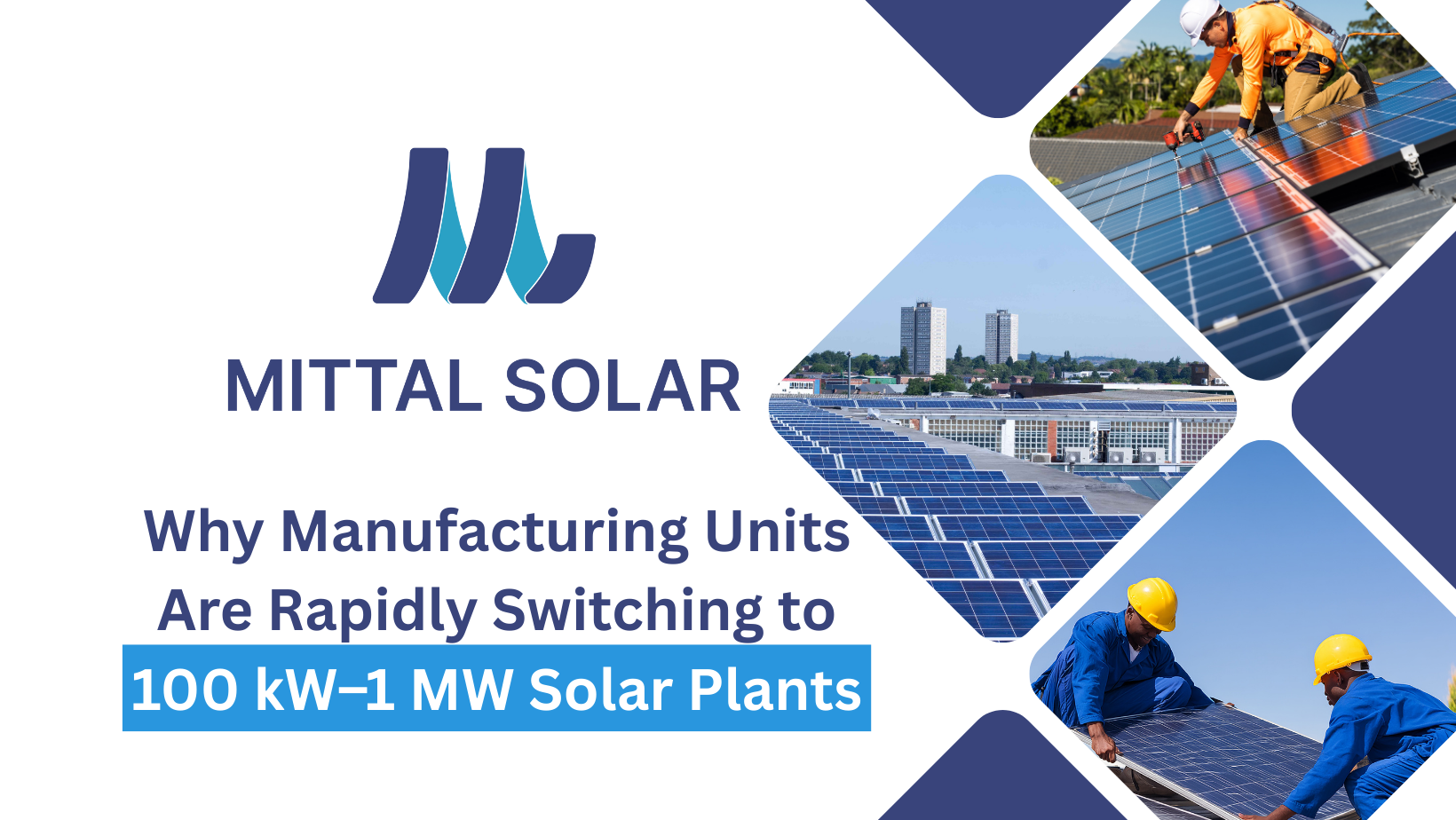
Why Manufacturing Units Are Rapidly Switching to 100 kW–1 MW Solar Plants
India’s manufacturing sector is going through a major transformation. With rising electricity costs, increasing competition, and rapid technological advancement, industries are now looking for smarter, cleaner, and more economical ways to run their operations. Among all solutions available today, 100 kW to 1 MW solar power plants have emerged as the most reliable, cost-effective, and future-ready energy source for factories and industrial units.
From textile mills to plastic molding units, metal fabrication workshops to food-processing plants, businesses across India are adopting solar not just as an energy source but as a long-term strategic investment for sustainable growth. This blog explains why industrial units are rapidly switching to 100 kW–1 MW solar systems, and how this shift is reshaping the operational efficiency of the manufacturing ecosystem.