Megawatt Solar Projects Cost, Return on Investment, and Reasons for Industry Transitions
Commercial Solar
•
19 March, 2026
Megawatt scale solar plants are spearheading India's enormous transition to renewable energy. Industries all over the nation are quickly embracing solar power as a long-term solution due to growing electricity costs and an increased emphasis on sustainability. The cost of megawatt solar projects, ROI, and the reasons why industries are changing more quickly than before will all be covered in this article.
1. A megawatt solar project: what is it?
A megawatt (MW) solar project is a large-scale solar power system that is usually utilized by commercial establishments, industries, or utility-scale enterprises. These systems can have capacities ranging from 1 MW to hundreds of megawatts. These kinds of tasks are perfect for: • Manufacturing sectors • Big factories • Logistics parks and warehouses • Business complexes
2. Megawatt Solar Project Costs in India
A megawatt solar project's cost is determined by a number of variables, including installation type, technology, and location. Average Price (Estimated for 2026): • The cost of a 1 MW solar plant is between ₹3.5 and ₹5 crore. Cost Distribution: 50–55% of solar panels • 10–15% of inverters • Mounting & Structure: 10–12% • 15–20% for installation and EPC services • Other: 5% Cost-Affecting Factors: The availability of land • The kind of panels (bifacial, mono PERC, etc.) • Subsidies and programs of the government • Connectivity to the grid
3. Megawatt Solar's ROI (Return on Investment)
The good return on investment of solar energy is one of the main reasons enterprises are embracing it. Important Financial Information • Three to five years is the payback period. • Project Life: more than 25 years • Depending on pricing, annual savings might reach ₹1–1.5 crore per MW. Example: If an industry invests ₹4 crore in a 1 MW solar plant: • Savings per year: ₹1.2 crore • Payback was made in about 3.5 years. • Pure profit and savings over the next 20 years or more
4. Reasons for Industry Transitions to Megawatt Solar
-
Growing Electricity Prices India's industrial power rates are rising annually. For decades, solar energy has helped keep energy costs stable.
-
ESG and Sustainability Objectives In order to achieve ESG (Environmental, Social, and Governance) goals and enhance their brand image, businesses are concentrating on green energy.
-
Self-sufficiency in Energy Businesses are shielded from power outages and price swings by solar energy, which also lessens reliance on the grid.
-
Government Assistance Solar energy is being aggressively promoted by the Indian government through: • Policies for net metering Benefits of accelerated depreciation • Policies for open access
-
An edge over competitors By lowering production costs, solar-powered industries may become more competitive.
5. Types of Megawatt Solar Installations
-
Solar Power on the Ground • Ideal for expansive land areas • Increased effectiveness • Perfect for projects at the utility scale
-
Large-scale rooftop solar • Fit for warehouses and factories • Conserves space • Lowers transmission losses
-
Solar Access Install a solar power plant in a remote area. • Use the grid to directly supply electricity to industries
6. EPC's Significance in Megawatt Solar Projects
For a project to be successful, engineering, procurement, and construction, or EPC, is essential. A trustworthy EPC partner guarantees: • Appropriate system architecture • Superior materials • Project completion on schedule • Performance over time Your ROI and system efficiency might be greatly impacted by your choice of EPC provider.
7. Megawatt Solar's Future in India
Solar energy will account for a significant portion of India's 500 GW of renewable energy capacity by 2030. Important trends • The use of bifacial solar panels • The expansion of solar parks • A rise in industrial involvement • Declining solar installation expenses
8. Why this is the ideal time to invest
Megawatt solar installations are increasingly essential for enterprises, not simply a choice. Solar power is the best investment for the future due to its high return on investment, long-term savings, and environmental advantages. Making the transition to solar power now might benefit your company if it uses a lot of electricity: Cut down on operating expenses, Boost revenue and Reach sustainability objectives
Conclusion
Megawatt solar installations are increasingly essential for enterprises, not simply a choice. Solar power is the best investment for the future due to its high return on investment, long-term savings, and environmental advantages. Making the transition to solar power now might benefit your company if it uses a lot of electricity: Cut down on operating expenses, Boost revenue and Reach sustainability objectives
Table of Content
- Introduction
- A megawatt solar project: what is it?
- Megawatt Solar Project Costs in India
- Megawatt Solar's ROI (Return on Investment)
- Reasons for Industry Transitions to Megawatt Solar
- Types of Megawatt Solar Installations
- EPC's Significance in Megawatt Solar Projects
- Megawatt Solar's Future in India
- Why this is the ideal time to invest
- Conclusion
Related Posts

Smart Energy for Smart Businesses: How Commercial Solar Solutions Lower Industrial and Commercial Building Electricity Costs
One of the most significant operating costs for businesses, apartment complexes, hospitals, hotels, and gas stations is electricity. Businesses are actively looking for solutions to lower monthly power expenditures without sacrificing energy quality or dependability due to growing energy prices and a greater emphasis on sustainability. With long-term financial benefits, energy independence, and a reduced carbon footprint, commercial solar energy solutions have become a clever, economical, and environmentally responsible substitute for traditional grid electricity.

The Top Benefits of Solar Panels for Commercial Buildings 2025
All solar panels for commercial buildings appear to have answered the call in becoming the solution to sustainability and cost savings. Thanks to technology, 2025 presents itself to be a game-changing year for businesses that want to minimize energy costs, switch to lower-carbon alternatives, and enhance their marketability. Commercial Solar Solutions supports businesses and commercial establishments save on utility bills while improving their credibility in environmental stewardship—a much-valued aspect in modern business. Without a doubt, from small offices to large industrial complexes, recognizing the benefits of solar panels can create the most value for your enterprise, provide it with increased competition and resilience, and better ensure sustainable operations. Solar panels for commercial buildings stand out, in that they provide a game-changing solution to renewable energy by being a means for cost savings, as well as a way for sustainability in the ecosystem and regulatory compliance with the present stakeholders.
Having an industry or commercial building in Bhopal, Madhya Pradesh gives you easy access to commercial solar panel installations. One of the best plans that you can cater to is “Rooftop Commercial Solar Panels”. But how?
Let us explore the key benefits in detail in a segmented view of actionable insights.
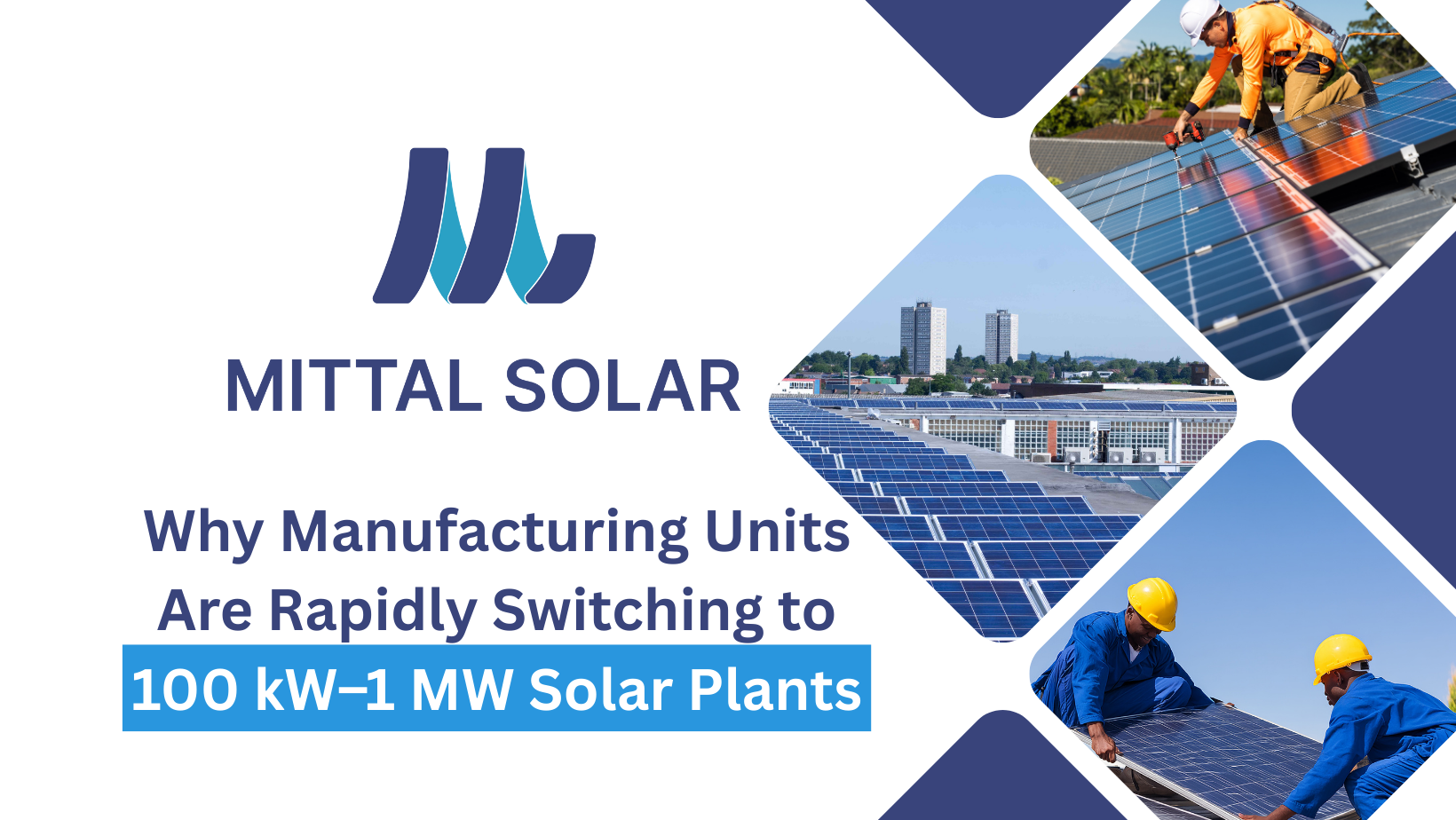
Why Manufacturing Units Are Rapidly Switching to 100 kW–1 MW Solar Plants
India’s manufacturing sector is going through a major transformation. With rising electricity costs, increasing competition, and rapid technological advancement, industries are now looking for smarter, cleaner, and more economical ways to run their operations. Among all solutions available today, 100 kW to 1 MW solar power plants have emerged as the most reliable, cost-effective, and future-ready energy source for factories and industrial units.
From textile mills to plastic molding units, metal fabrication workshops to food-processing plants, businesses across India are adopting solar not just as an energy source but as a long-term strategic investment for sustainable growth. This blog explains why industrial units are rapidly switching to 100 kW–1 MW solar systems, and how this shift is reshaping the operational efficiency of the manufacturing ecosystem.