How Industrial Solar Power Can Reduce Factory Electricity Bills by 80% by 2026
Commercial Solar
•
18 March, 2026
Rising electricity costs are one of the main obstacles facing business owners in today's cutthroat economic environment. Energy costs can consume a significant amount of your earnings, regardless of whether you operate a manufacturing facility, warehouse, or processing plant. However, what if you could cut those expenses by as much as 80%? Welcome to Industrial Solar Power, the energy of the future. In 2026, converting to solar power is not only a cost-effective move that can revolutionize your company, but it's also an eco-friendly one.
1. Why Industries Are Seeing an Increase in Electricity Prices
India's industrial users' electricity prices are still rising because of: • Growing fuel prices • Grid infrastructure expenses • Surcharges for peak demand • Reliance on fossil fuels Electricity contributes 20% to 40% of operating costs in many enterprises. That is a significant cost that has an immediate effect on profitability.
2. Industrial Solar: What Is It?
Large-scale solar power systems mounted on open space or factory rooftops are referred to as industrial solar. Heavy machinery, production lines, and entire facilities can be powered by these solar-powered systems. There are mostly two kinds: • Solar systems that are on the grid and linked to DISCOM • Solar power plants in captivity (for specific industrial usage)
3. How Industrial Solar Can Reduce Expenses by Up to 80%
- Generation of Electricity at No Cost Once built, solar panels use sunshine to produce electricity for free. This significantly lessens reliance on grid power.
As a result, monthly electricity bills are immediately reduced.
-
Advantages of Net Metering Excess electricity produced is returned to the grid through net metering. You receive credits, which lower your cost even further.
-
Defense Against Tariff Increases Solar energy secures your cost for more than 25 years, while electricity rates will continue to rise. Consistent and predictable energy costs
-
Tax Benefits & Government Subsidies Industries stand to gain from: • A 40% increase in depreciation • State-level rewards • GST advantages Faster ROI with a less initial investment
-
Low Cost of Maintenance Minimal maintenance is needed for solar systems: Cleaning on occasion • Basic maintenance The annual maintenance cost is around 1% to 2%.
Actual Example: Calculating Cost Savings Let's look at an example factory:• The monthly electricity bill is ₹5,00,000. • The annual cost is ₹60,00,000. Following the installation of industrial solar: • 70–80% of usage is covered by solar • The new yearly bill is ₹12–18 lakhs. Savings: ₹40–48 lakhs annually That is a huge save!
ROI: How Quickly Is Your Investment Recovered? The payback period for the majority of industrial solar systems is: 3 to 5 years For the next twenty years or more, electricity is essentially free after that.
Industries That Gain the Most from Industrial Solar: • Production facilities • The textile sector • Warehouses and cold storage • Plants that process food • The automotive sector • Pharmaceutical firms Solar energy is ideal if your factory operates during the day.
4. Environmental Advantages (Bonus Advantage)
Making the switch to solar energy benefits the environment in addition to saving money: • Lowers emissions of carbon • Encourages sustainable energy • Enhances the image of the brand Excellent for drawing in eco-aware customers and ensuring ESG compliance.
5. Why Going Solar Is Best in 2026
In 2026, industries are quickly embracing solar power for the following reasons:• Growing prices for power • Higher efficiency due to improved solar technology • The government actively promotes renewable energy • Simple financing and EMI choices Early adopters benefit financially the most.
6. Common Misconceptions Regarding Industrial Solar
["Solar energy is too costly."] Truth: It's very affordable with financing and incentives. ["It requires a lot of upkeep."] Truth: Very little upkeep is needed. ["In cloudy weather, it won't work."] The truth is that solar energy still produces power, albeit marginally less.
7. Selecting the Appropriate Solar EPC Partner
Selecting the best installer is essential to maximizing savings. Search for: • A seasoned EPC firm • Verified industrial initiatives • Superior solar panels • Robust post-purchase assistance A strong EPC partner guarantees ROI and long-term performance.
Conclusion
In 2026, industrial solar will become a commercial requirement rather than an option. Your factory can save up to 80% on electricity expenditures by converting to solar power. Become energy independent, boost revenue, and Help create a more environmentally friendly future
Table of Content
- Introduction
- Why Industries Are Seeing an Increase in Electricity Prices
- Industrial Solar: What Is It?
- How Industrial Solar Can Reduce Expenses by Up to 80%
- Environmental Advantages (Bonus Advantage)
- Why Going Solar Is Best in 2026
- Common Misconceptions Regarding Industrial Solar
- Selecting the Appropriate Solar EPC Partner
- Conclusion
Related Posts
Smart Energy for Smart Businesses: How Commercial Solar Solutions Lower Industrial and Commercial Building Electricity Costs
One of the most significant operating costs for businesses, apartment complexes, hospitals, hotels, and gas stations is electricity. Businesses are actively looking for solutions to lower monthly power expenditures without sacrificing energy quality or dependability due to growing energy prices and a greater emphasis on sustainability. With long-term financial benefits, energy independence, and a reduced carbon footprint, commercial solar energy solutions have become a clever, economical, and environmentally responsible substitute for traditional grid electricity.

The Top Benefits of Solar Panels for Commercial Buildings 2025
All solar panels for commercial buildings appear to have answered the call in becoming the solution to sustainability and cost savings. Thanks to technology, 2025 presents itself to be a game-changing year for businesses that want to minimize energy costs, switch to lower-carbon alternatives, and enhance their marketability. Commercial Solar Solutions supports businesses and commercial establishments save on utility bills while improving their credibility in environmental stewardship—a much-valued aspect in modern business. Without a doubt, from small offices to large industrial complexes, recognizing the benefits of solar panels can create the most value for your enterprise, provide it with increased competition and resilience, and better ensure sustainable operations. Solar panels for commercial buildings stand out, in that they provide a game-changing solution to renewable energy by being a means for cost savings, as well as a way for sustainability in the ecosystem and regulatory compliance with the present stakeholders.
Having an industry or commercial building in Bhopal, Madhya Pradesh gives you easy access to commercial solar panel installations. One of the best plans that you can cater to is “Rooftop Commercial Solar Panels”. But how?
Let us explore the key benefits in detail in a segmented view of actionable insights.
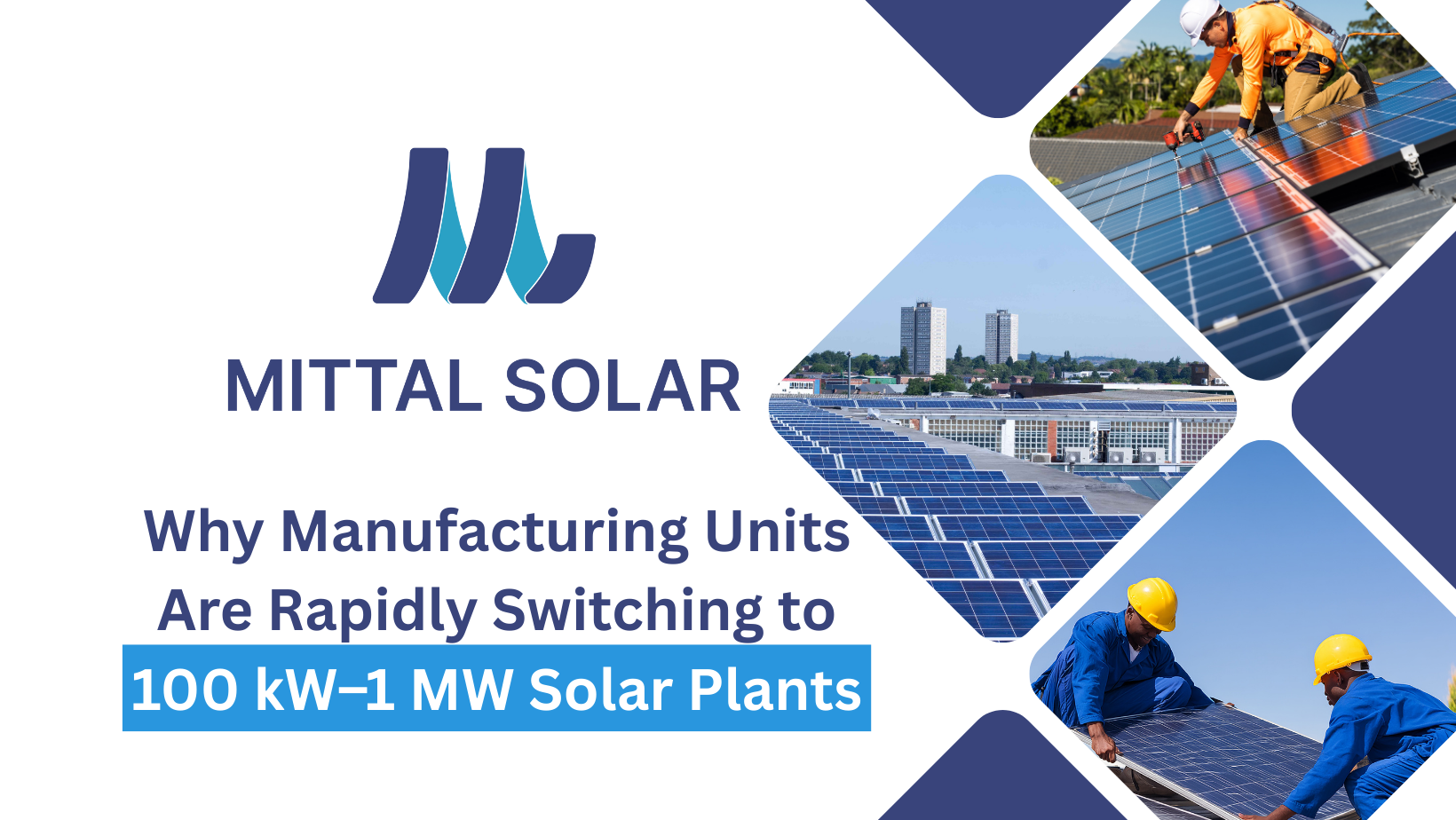
Why Manufacturing Units Are Rapidly Switching to 100 kW–1 MW Solar Plants
India’s manufacturing sector is going through a major transformation. With rising electricity costs, increasing competition, and rapid technological advancement, industries are now looking for smarter, cleaner, and more economical ways to run their operations. Among all solutions available today, 100 kW to 1 MW solar power plants have emerged as the most reliable, cost-effective, and future-ready energy source for factories and industrial units.
From textile mills to plastic molding units, metal fabrication workshops to food-processing plants, businesses across India are adopting solar not just as an energy source but as a long-term strategic investment for sustainable growth. This blog explains why industrial units are rapidly switching to 100 kW–1 MW solar systems, and how this shift is reshaping the operational efficiency of the manufacturing ecosystem.