2026 Government Solar Subsidy in India Eligibility Criteria and Application Process in India
Government Policies
•
21 January, 2026
making an aggressive shift to clean energy, the uptake of rooftop solar is becoming one of the fastest-developing trends among households. In 2026, the Indian government maintained its support for this transition through strong subsidy programs and incentives, rendering solar energy more affordable and accessible than it had ever been. If you are a homeowner interested in reducing electricity costs, or an individual prepared to put money into renewable energy, grasping the solar subsidy landscape in 2026 can aid you in saving thousands of rupees and help foster a greener future. The Importance of rooftop solar installation Subsidies in 2026
1. The cost of electricity is still increasing throughout India.
Along with worries about climate change, solar energy presents a clean and economical option. Subsidies for solar energy: • Lower the initial installation costs • Increase investment returns • Promote widespread uptake in both urban and rural areas of India • Back national goals for renewable energy The government intends to reach a rooftop solar capacity of 40,000 MW by March 31, 2026, under the Grid-Connected Rooftop Solar Programme (Phase II). In order to accomplish this ambitious target, considerable financial incentives and simplified application procedures have been implemented.
2. Who qualifies for the solar subsidy in 2026?
- Users in Residence (Main Beneficiaries) Residential rooftop consumers are the main target of the 2026 solar subsidy. Any Indian citizen who has a valid electricity connection and owns rooftop space can apply for the subsidy, as long as the system is grid-connected. Key Eligibility Criteria: ✔ Must reside in India ✔ Must possess or legally control rooftop space ✔ Must have a valid electricity connection in your name from DISCOM ✔ Must use MNRE-approved vendors and BIS (Bureau of Indian Standards) certified equipment for solar installation Important Note: Under this scheme, the central solar subsidy is only available for residential systems, meaning that commercial and industrial consumers do not qualify. Structure of Subsidies in 2026 With the PM Surya Ghar Muft Bijli Yojana (Rooftop Solar Scheme), the government offers direct subsidies that depend on the capacity of your solar system Residential Subsidy Guide System Capability Grant Sum Up to 2 kW, the cost is ₹30,000 for each kW 2–3 kW: ₹18,000 for each kW Max Subsidy ₹78,000 total Clarification: • When you set up a system of up to 2 kW, you receive ₹30,000 for every 1 kW. • For a range of 2 to 3 kW, the amount you receive is ₹18,000 for each additional kW. • The upper limit for the subsidy for systems exceeding 3 kW is ₹78,000. This arrangement guarantees enhanced backing for smaller residential systems, as they are most affected economically.
3. Step-by-Step Guide: Application Process for Solar Subsidy in 2026
It is now mostly online and more efficient to apply for your solar subsidy. The process is simple: Step 1: Select a Certified Solar Vendor Select an installer that has MNRE approval and is empanelled with your state DISCOM. The subsidy is only available for installations carried out by these approved vendors. Step 2: Go to the National Solar Rooftop Portal Visit the official rooftop solar portal — usually pmsuryaghar.gov.in or solarrooftop.gov.in and choose “Apply for Rooftop Solar in Bhopal”. Step 3: Sign up and enter your details It will be necessary for you to provide the following information: ✔ Your electricity consumer number ✔ Your mobile number and email address ✔ Your personal details along with your property address ✔ Specifications of your roof Step 4: Upload Necessary Documents Upload scanned versions of all documents, including Aadhaar, electricity bill, bank account details, and property proof. Step 5: Choose System Capacity and Vendor Select the size of solar system you want (e.g. 3 kW) and your approved vendor from the provided list. Step 6: Verification by DISCOM The local DISCOM will check feasibility. In some states, systems of up to 10 kW can utilize fast-track approval processes that do not require a technical feasibility study. Step 7: Installation Your vendor installs the solar panels once approved. All panels and inverters must comply with BIS certification and safety standards. Step 8: Review & Net Metering Once installed, the item is physically inspected. At this point, you also submit an application for net metering, allowing excess solar energy to reduce future electricity costs. Step 9: Disbursal of Subsidy Once all aspects are confirmed and the system is put into operation, the grant will be directly transferred to your bank account via DBT (Direct Benefit Transfer), typically within 30 to 60 days.
4. Important Notes Only New Systems Are Eligible
Solar systems that are already in place or expansions of these, as well as systems that have not undergone a subsidy application process, cannot receive a subsidy. Support from central subsidies is limited to capacities of up to 3 kW. For larger systems, there is no additional subsidy, but you can take advantage of net metering to lower your bills. Industrial & Commercial Systems Although these installations usually do not qualify for rooftop solar subsidies, they can still take advantage of tax incentives and accelerated depreciation under various policies that are not part of this scheme. Your Potential Savings The subsidy makes it possible for the cost of installing a 3 kW rooftop solar system, which usually ranges from ₹1.8 to ₹2.1 lakh, to be reduced to around ₹1 to ₹1.3 lakh—this depends on the quality of the panels and the installation fees. Moreover, due to net metering, numerous households see their bills decrease by as much as 70–90%.
Conclusion
Net Metering: Amplify Your Savings With net metering, any surplus solar energy you produce can be credited toward your future electricity consumption. This implies: Reduce bill costs even during months without sunshine Utilize grid electricity when necessary Significantly decrease total energy expenditure Many DISCOMs now provide support for group net metering and virtual net metering, making solar energy feasible for apartments and collective housing societies. Concluding Reflections In 2026, the Government of India implemented solar subsidy schemes that made rooftop solar energy affordable, accessible, and financially beneficial for millions of residential consumers nationwide. With the introduction of direct financial assistance, simple online application processes, and net metering, solar energy has transitioned from a niche investment to a widely accepted option for those seeking energy independence. This year is the best opportunity yet to consider going solar, whether you aim to reduce your electricity costs, enhance your property value, or help make India greener.
Table of Content
- Introduction
- The cost of electricity is still increasing throughout India.
- Who qualifies for the solar subsidy in 2026?
- Step-by-Step Guide: Application Process for Solar Subsidy in 2026
- Important Notes Only New Systems Are Eligible
- Conclusion
Related Posts
2026 Government Solar Subsidy in India Eligibility Criteria and Application Process in India
making an aggressive shift to clean energy, the uptake of rooftop solar is becoming one of the fastest-developing trends among households. In 2026, the Indian government maintained its support for this transition through strong subsidy programs and incentives, rendering solar energy more affordable and accessible than it had ever been. If you are a homeowner interested in reducing electricity costs, or an individual prepared to put money into renewable energy, grasping the solar subsidy landscape in 2026 can aid you in saving thousands of rupees and help foster a greener future. The Importance of rooftop solar installation Subsidies in 2026
PM-KUSUM Yojana: How Farmers Can Benefit from Solar Energy
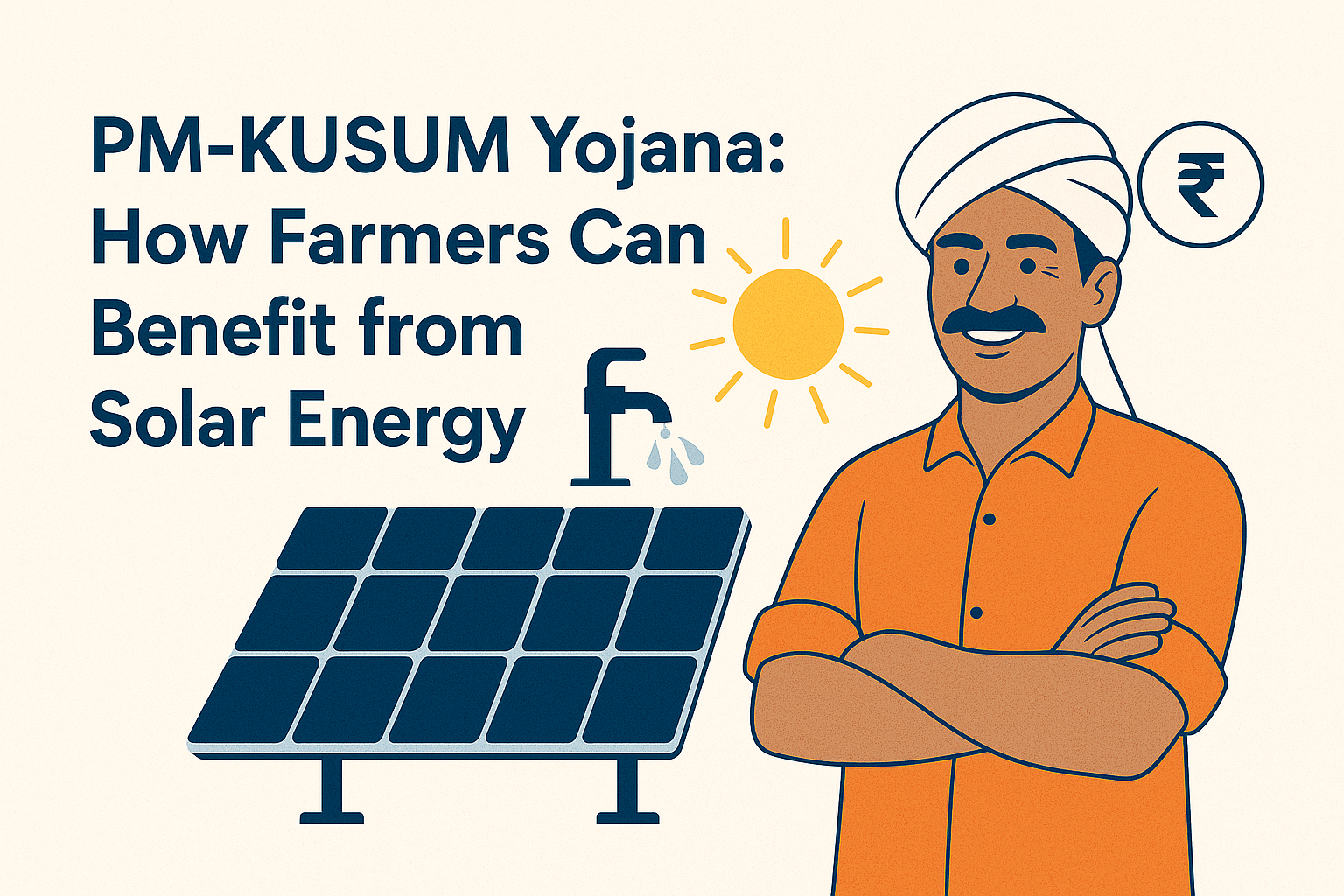
The Pradhan Mantri Kisan Urja Suraksha Evam Utthan Mahabhiyan (PM-KUSUM) Yojana is a government initiative aimed at promoting solar energy adoption among farmers. Launched by the Ministry of New and Renewable Energy (MNRE), this scheme helps farmers reduce their dependence on grid electricity and diesel pumps while generating additional income through solar power.
In this blog, we will explore how farmers can benefit from the PM-KUSUM Yojana and how to apply for the scheme.
Solar Power Subsidy in Madhya Pradesh 2024: A Comprehensive Guide
Madhya Pradesh, one of India’s most resource-rich states, is making significant strides toward renewable energy, particularly solar power. With abundant sunshine throughout the year, the state is an ideal candidate for harnessing solar energy to meet its growing power needs. The government—both at the center and state level—has launched several initiatives to promote solar energy adoption. Among these are solar power subsidies and incentives, which aim to make solar installations more affordable for residents, businesses, and farmers.
In this guide, we’ll provide an overview of the solar power subsidy schemes available in Madhya Pradesh for 2024, explain the eligibility criteria, and help you understand how to apply for these subsidies.